Hands-on chart
Mitre Peak on a Milford Sound cruise
2-hour small-boat cruise on Milford Sound
★ 4.8 · 3,033 reviews total
Mitre Peak through the year
Light on the peak, month by month
Choose a month to see sunrise, sunset and day length at Milford Sound, and what the season does to the view of Mitre Peak.
Sunset
Jan
- Sunset approx. 21:33
Summer: explore early in the morning or late in the afternoon and evening, Visit Fiordland says.5
Feb
- Sunset approx. 21:00
A cool breeze often builds through summer days, so look for flat water early.5
Mar
- Sunset approx. 20:12
Autumn mornings and evenings turn cooler, with misty scenes around the summit.23
Sunrise and sunset are worked out for Milford Sound on New Zealand time, with daylight saving in the summer months. The notes come from Visit Fiordland and the cruise operators, because no weather station lies close to the fiord.
Mitre Peak on a Milford Sound cruise is a different mountain from the one on the postcards. Here is what you are looking at, why it has its name, and when the light and the water treat it best.
Editorial team, milfordsoundcruise.click · Updated November 8, 2026 · ~7 min read
The mountain that stands in the water
Most mountains start somewhere above you, behind foothills and forest. Mitre Peak starts at the waterline. DOC measures its sheer walls at 1,692 m from the water's edge to the top, and counts it among the most recognised and photographed mountains on Earth.1 On the cruise you pass beneath that wall, close enough to see that the green is forest clinging to rock and not a gentle slope.
Tourism New Zealand calls it a one-kilometre-high mountain, a rounder way of saying the same thing.6 What makes it look so much taller is that nothing interrupts the line from summit to sea. Your eye starts at the boat's rail and has to travel all the way up a single face, and from the deck the top often vanishes into cloud before your eye gets there.
Below the waterline the rock keeps going. Underwater, DOC says, the slopes carry on down as far as 265 m.7 So the face you see is only the upper part of a single sweep of rock carved by ice, and the cruise boat is floating somewhere along its middle. Remember that when the water looks black and still beneath you.
Where to look from
Viewpoints for Mitre Peak
| Viewpoint | How you get there | What you get |
|---|---|---|
| Foreshore Walk | A 400 m loop from the car park11 | The classic reflected view |
| Lookout Track | A 20 min track with steps12 | A higher view down the fiord |
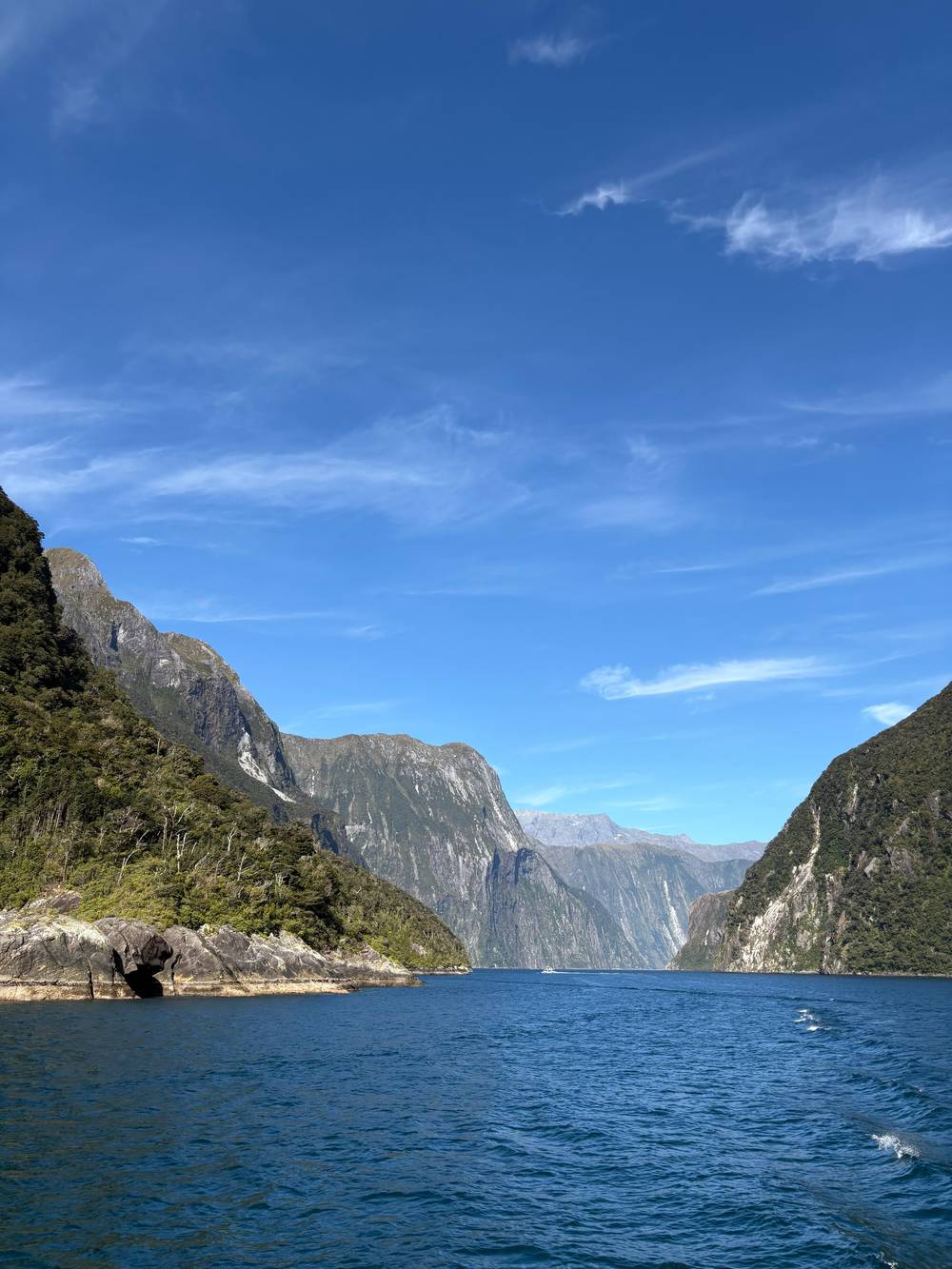
| Outbound deck | On the cruise | The face rising above the boat |
| Homeward stern | On the cruise | The peak behind the wake |
| Terminal shore | Before you board | The peak with boats in front |
Walk details from DOC; the boat's order of sides can change with the day.13,14
A bishop's hat, and five summits in one
The English name is a visual joke that stuck. Mitre Peak Cruises says the peak is named for its likeness to a bishop's mitre, the tall pointed headdress, and the resemblance is strongest from the head of the fiord, where the twin slopes meet in a sharp point.2 From the side, as you pass on the boat, the shape changes and the mitre turns into a long jagged ridge.
That ridge is the clue to a detail most visitors miss. Mitre Peak Cruises points out that the summit is really 5 peaks grouped tightly together, which from the terminal line up and merge into a single point.2 Watch for them separating as the boat moves out along the fiord; it is one of the small rewards of seeing the mountain from the water rather than from the shore.
Visit Fiordland writes the Māori name beside the English one: Rahotu / Mitre Peak.3 The fiord itself has a Māori name too, Piopiotahi, named, DOC says, for the piopio, a native thrush that has probably died out.10 This site uses both names, as the official bodies do.
Where the classic photograph is taken
The famous view, the one with the peak reflected in still water, is taken from land. DOC points to the Milford Sound Foreshore Walk for some of the finest Mitre Peak views; it is a 400 m loop from the main visitor car park.4,11,13 It is easy, fine for all ages and wheelchair friendly, so it fits neatly into the time before or after your sailing.15
From the foreshore you also get the boats themselves in the frame. DOC mentions watching the cruise boats head out along the fiord from this walk, which is what gives the classic picture its sense of scale: a tiny vessel at the foot of an enormous peak.16 If you are waiting for a later departure, walk it first, then board and see the same mountain from the other side.
The walk comes with one warning. DOC says there may be a lot of sandflies there, so put repellent on before you leave the car.19 Mitre Peak Cruises sells insect repellent at its desk for exactly this reason.20 The bites are harmless but very itchy, and they are the price of standing still long enough to take a good photograph.
Your Mitre Peak photo
Which picture are you after?
Each shot of the peak has its own place and time.
If The mirror-calm reflection
Foreshore, early
If The boat dwarfed by the peak
Foreshore, as boats leave
You can watch the cruises head out.16
If The wall towering overhead
Outer deck, outbound
It rises straight from the water.1
If Snow on the summit
A winter cruise
Snow is seen on the mountains in winter.17
If Cloud and mood
A showery day
Low cloud gives the most dramatic views.18
Mitre Peak reflection from a boat cruise
A Mitre Peak reflection from a boat cruise needs flat water, and flat water is a morning thing more often than not. Mitre Peak Cruises suggests a morning sailing if you can, because the light is lovely then and the surface is often flatter, and RealNZ says mornings are often calmer and quieter.8,9 Wind usually builds as the day warms, ruffling the surface.
Visit Fiordland makes a related point for summer: warm air rising brings a cool breeze through the day, and the best times to explore are early morning or late afternoon and evening.5 On the water, that translates into glassy patches near the walls in the first sailings and again late in the day, with chop in between. Midday still has its own gift, which RealNZ describes as brighter light for photography.9
From a moving boat a clean reflection lasts only seconds, so be ready before the boat turns. Stand near the stern on the way home, when the peak sits behind the boat and the wake has not yet reached that patch of water. If the wind is up, aim for the reflection of the cliffs close to the hull instead; it often survives when the open water is broken.
A day on the peak
How Mitre Peak changes through the day
How the light moves across the face
The peak stands on the south shore of the fiord, as Mitre Peak Cruises describes it, and in New Zealand the sun travels across the northern sky.2 That means the faces you see from the terminal and from the boat on the way out catch the morning sun from the east and north, while in the afternoon the sun swings round behind the western ridges and the peak turns darker and more dramatic.
The sun tool on this page shows sunrise, sunset and day length for every month at Milford Sound. In summer the long days give you light at both ends of the cruise timetable; in winter the sun sits low and the fiord walls keep the water in shade for much of the day. Visit Fiordland notes that winter daylight hours are much shorter but that it is the most settled time of the year, with skies often blue and cloudless.21
Snow changes the picture again. Visit Fiordland says that in winter snow is seen on the mountains, and Mitre Peak Cruises calls Mount Pembroke snow-capped on its commentary.17,22 Autumn brings its own mood: cooler mornings and evenings that create misty scenes, according to Visit Fiordland, which is when the summit plays hide and seek with the cloud.23
Video
Climbing Mitre Peak above Milford Sound in a day
Tamsin Danielle on YouTube · The video only starts loading on your tap.
Rising 1692 metres, seemingly sheer above the Sound, the summit actually consists of five closely grouped individual peaks
Photographing the peak
A Mitre Peak checklist
Before the cruise4
On the water4
- Watch the summit split into its 5 peaks as you pass2
- Take the stern on the way home for the view back
- Carry a lens cloth against the spray
- Bring a hat: it is colder on the open deck
Seeing it in cloud and rain
Many cruises happen in rain, and the peak may be hidden for much of the trip. That is not a lost cause. Rain falls on roughly 180 days a year, by Tourism New Zealand's count, so cloud is part of the place.24 When it lifts, even for a minute, the summit appears suddenly above the waterfalls, and those glimpses are among the most striking views of the day.
In Mitre Peak Cruises' view, mist and low cloud give the fiord its moodiest look, and only thick fog really spoils the photographs.18,25 In practice, a day of drifting cloud often gives you better pictures of the peak than a flat grey one with clear air, because the cloud gives the mountain depth and layers.
If the peak stays hidden, the cruise still shows you its base, the walls that drop into the water and the falls running down them. Spring can bring higher rainfall and even snow down to sea level, according to Visit Fiordland, so the lower slopes can be dusted white even when the summit is lost.26 Keep looking up; the cloud moves faster than you expect.
Why the peak looks the way it does
Mitre Peak is a product of ice. Ice came and went across Fiordland repeatedly during the last 2 million years, DOC says, scooping out the U-shaped troughs that now hold its lakes and fiords.27 The steep bare walls of hard rock, gneiss, diorite and granite among them, were ground and rounded by that ice, which is why the peak's lower faces are so smooth and so steep.28
Milford's own trough took shape in the glacial period from 80,000 to 12,000 years ago, by Visit Fiordland's dating.29 The summit ridges stood above the ice and were left sharp, while everything below was planed into a wall. That contrast between a jagged top and a polished base is what gives the mountain its strange, sculpted look from the water.
The story of how the fiord formed, including the Ngāi Tahu account of its carving, has its own page on this site. For the cruise, the point is simpler: you are sailing along the floor of a valley the ice dug out, and Mitre Peak is the part of its wall that was too hard and too high to be worn down. Look at it with that in mind and its shape makes sense.
FAQ
Common questions, answered fast.
How tall is Mitre Peak?
DOC says its walls rise 1,692 m straight from the water.1
Why is it called Mitre Peak?
Mitre Peak Cruises explains the name by its resemblance to a bishop's headdress.2
What is the Māori name for Mitre Peak?
Visit Fiordland writes Rahotu / Mitre Peak.3
Is Mitre Peak a single summit?
Mitre Peak Cruises says its summit is 5 closely grouped peaks.2
Where is the best view of Mitre Peak?
When is the water calm enough for a reflection?
Sources
- Department of Conservation · Milford Road/Milford Sound area: Fiordland National Park ↩
- Mitre Peak Cruises (operator official site) · About Milford Sound ↩
- Visit Fiordland (regional tourism organisation) · Milford Sound Piopiotahi ↩
- Department of Conservation · Milford Road/Milford Sound area: Fiordland National Park ↩
- Visit Fiordland (regional tourism organisation) · Milford Sound Piopiotahi ↩
- Tourism New Zealand · Visit Milford Sound / Piopiotahi ↩
- Department of Conservation · Milford Road/Milford Sound area: Fiordland National Park ↩
- Mitre Peak Cruises (operator official site) · The Ultimate Guide to Milford Sound Cruises ↩
- RealNZ (operator official site) · Milford Sound Signature Cruise ↩
- Department of Conservation · Milford Road/Milford Sound area: Fiordland National Park ↩
- Department of Conservation · Milford Foreshore Walk ↩
- Department of Conservation · Milford Sound Lookout Track ↩
- Department of Conservation · Milford Foreshore Walk ↩
- Department of Conservation · Milford Sound Lookout Track ↩
- Department of Conservation · Milford Foreshore Walk ↩
- Department of Conservation · Milford Foreshore Walk ↩
- Visit Fiordland (regional tourism organisation) · Milford Sound Piopiotahi ↩
- Mitre Peak Cruises (operator official site) · Will the weather ruin my trip to Milford? ↩
- Department of Conservation · Milford Foreshore Walk ↩
- Mitre Peak Cruises (operator official site) · Frequently Asked Questions ↩
- Visit Fiordland (regional tourism organisation) · Milford Sound Piopiotahi ↩
- Mitre Peak Cruises (operator official site) · About Us ↩
- Visit Fiordland (regional tourism organisation) · Milford Sound Piopiotahi ↩
- Tourism New Zealand · Visit Milford Sound / Piopiotahi ↩
- Mitre Peak Cruises (operator official site) · Will the weather ruin my trip to Milford? ↩
- Visit Fiordland (regional tourism organisation) · Milford Sound Piopiotahi ↩
- Department of Conservation · Fiordland National Park ↩
- Department of Conservation · Nature and conservation in Milford Road/Milford Sound area ↩
- Visit Fiordland (regional tourism organisation) · Natural History ↩
Continue reading